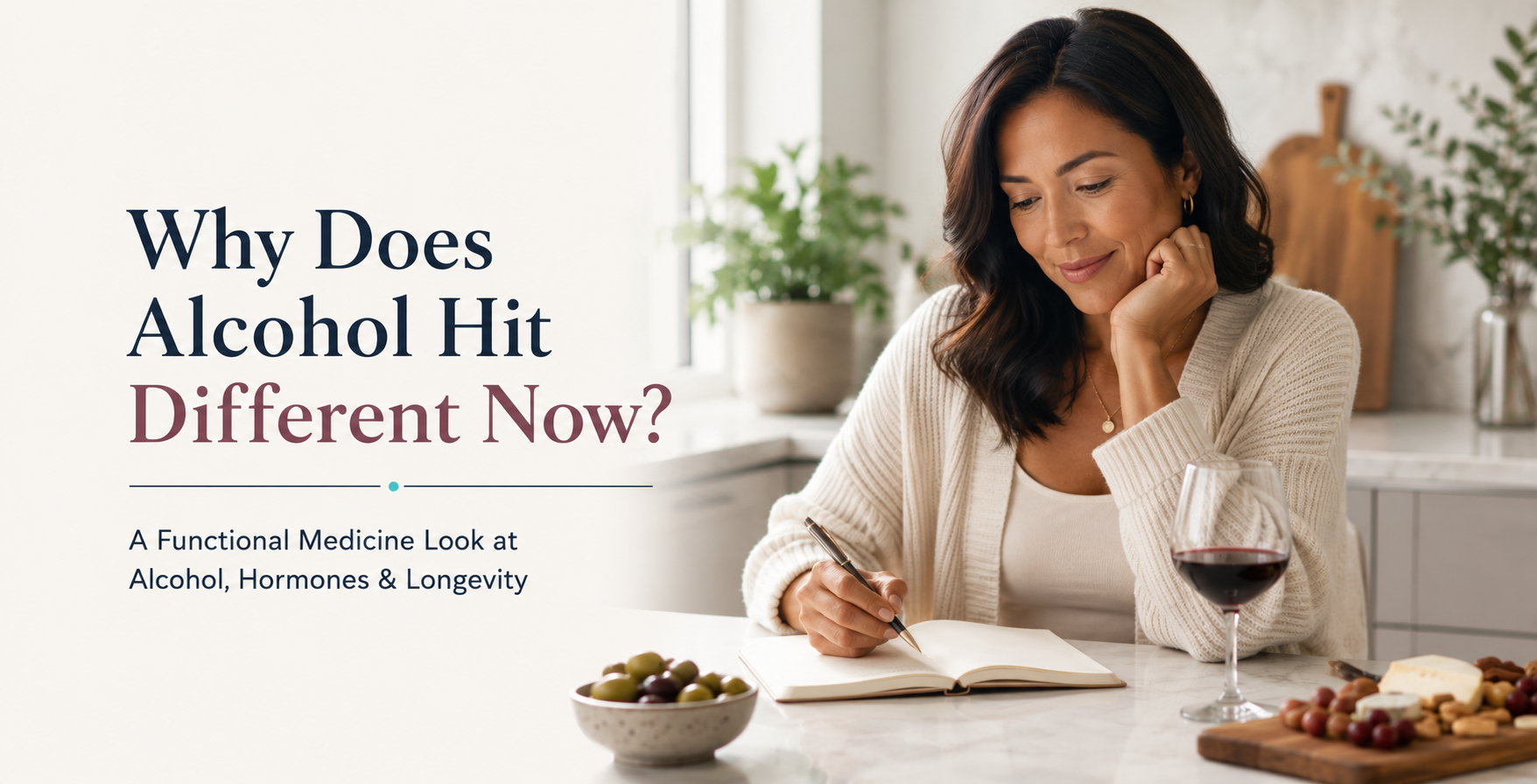
Two glasses of wine used to feel like nothing. You’d have a relaxed evening, sleep reasonably well, and wake up fine.
Now one glass leaves you hot in the middle of the night, awake at 3 a.m., puffy in the morning, and foggy for most of the next day. And you’re wondering: Did I suddenly become a lightweight? Is something wrong with me?
Nothing is wrong with you. But something has changed — and it’s worth understanding exactly what, because the explanation connects alcohol, hormones, and longevity in ways that should inform how you think about this, not just whether to finish the bottle.
Your liver is handling two jobs at once — and one of them is new
Alcohol has always been processed by the liver. What’s changed is that during perimenopause and menopause, your liver is simultaneously working harder on estrogen metabolism.
Estrogen doesn’t just appear and disappear. It goes through a multi-step processing sequence — through the liver, through gut bacteria, and out of the body. When estrogen levels are fluctuating wildly (as they do in perimenopause) or declining (as they do in menopause), the liver’s detoxification pathways are working overtime. Add alcohol to that queue, and the liver slows down on both tasks. Acetaldehyde — the toxic intermediate metabolite your body creates when breaking down alcohol — builds up faster. That’s what drives the flushing, the headache, the next-day fog.
It’s not that you’re suddenly more sensitive to alcohol. It’s that your liver has less capacity to spare.
Estrogen was quietly protecting you from alcohol’s effects
Here’s something most people don’t know: estrogen influences the activity of the enzymes (alcohol dehydrogenase and aldehyde dehydrogenase) that process alcohol. When estrogen levels decline, those enzymes become less efficient. The same amount of alcohol now produces more acetaldehyde, stays in your bloodstream longer, and causes more downstream disruption.
This is one of the physiological reasons women generally metabolize alcohol differently than men — and why perimenopausal and postmenopausal women are disproportionately affected. The buffer you didn’t know you had has changed.
Alcohol and sleep: amplified in midlife
If you’re already experiencing sleep disruption from hormonal shifts — the 3 a.m. wake-ups, the night sweats, the inability to fall back asleep — alcohol makes all of it worse. Even a modest amount suppresses REM sleep, disrupts your sleep architecture in the second half of the night, and interferes with the blood sugar stability that allows you to stay asleep. If cortisol is already elevated (common in perimenopause), alcohol worsens the cortisol rebound that jolts you awake at 3 a.m.
The glass of wine that used to help you unwind is now actively working against the sleep quality you’re already fighting for.
The longevity question
This is where I want to be both direct and honest with you, because the research here is important and the nuance matters.
Alcohol increases breast cancer risk — and that risk is dose-dependent, with no established safe lower limit. This has been consistent across large, high-quality studies. The mechanism is real: alcohol raises circulating estrogen, generates free radicals that damage DNA, and depletes folate — a nutrient critical for DNA repair.
For women in perimenopause and beyond, who are already navigating estrogen fluctuation and elevated cancer surveillance, this is information worth having. Not to generate fear, but to make an informed decision with your full biology in view.
From a longevity standpoint, alcohol also accelerates biological aging by increasing systemic inflammation, disrupting gut microbiome balance, and impairing the very cellular repair processes we’re trying to support. That doesn’t mean a glass of wine at a dinner party is destroying your health. It means the question “is alcohol working for or against my longevity goals?” is worth asking honestly.
What this actually looks like in practice
I’m not here to tell you to stop drinking. I am here to help you understand your biology well enough to make choices that feel right for you.
What I see in clinical practice: when women reduce alcohol — even significantly, not necessarily to zero — the improvements in sleep quality, next-day energy, skin, inflammation markers, and mood are often faster and more dramatic than they expected. The change they attributed to “getting older” frequently turns out to be the combination of hormonal shifts plus alcohol’s amplified impact on those exact systems.
Some questions worth sitting with:
- Is alcohol still giving you what it used to? Or has the cost-benefit shifted?
- Are you using it to manage stress, anxiety, or sleep — and would addressing those root causes directly feel better?
- If you reduced significantly for 30 days, what would you notice?
These are functional medicine questions. They’re not about willpower or judgment. They’re about whether what you’re doing is serving the biology you’re living in now.
If you want to go deeper on this — how alcohol interacts with your specific hormone picture, what your liver markers are telling you, and how to think about your longevity strategy in a way that’s built around your actual biology — I’m hosting a live conversation this Friday at 1 pm PST.
No slides. No pitch. Just an honest, clinically grounded discussion about what the research says and what it means for the women I work with.
Elizabeth Greenfield, RN, MS, IFMCP is the founder of Elizabeth Greenfield Functional Wellness, a precision functional medicine practice specializing in hormonal health across the menopausal journey, gut health, and biological age reversal.
This content is for informational purposes only and does not constitute medical advice.